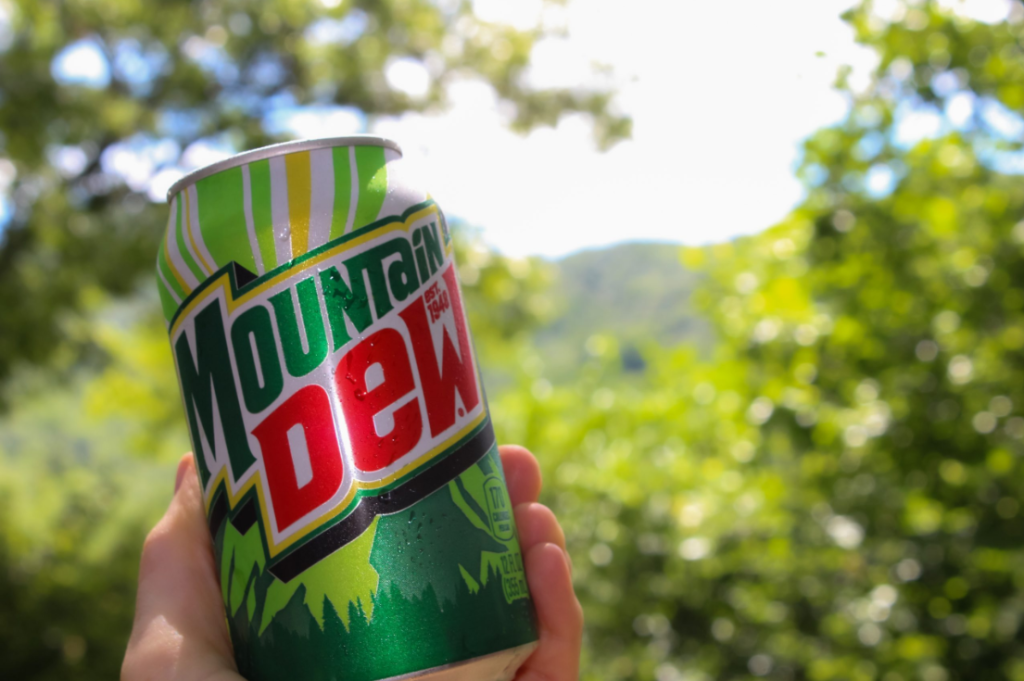
As a Mountain Dew aficionado, I remember when being a fan meant always having something new to look forward to. The drink has always been hard to beat, and I guarantee that my mix of corn syrup and caffeine is better than yours.
Jokes aside, one of the biggest things I’ve always loved about Mountain Dew is the sheer number of concoctions they’ve managed to produce, with estimates nearing 200 different flavors (if you include international and alcoholic flavors).
From the obscure “Aurora,” a flavor whose only proof of existence is a 1980s Japanese commercial, to… DEWitos – yes, a Mountain Dew flavor based on Spicy Nacho Doritos – tested on college campuses in the mid-2010s, they’ve truly done it all. (Let’s be grateful we weren’t there for that one.)
There are more normal flavors, too. My personal favorite is the Infinite Swirl flavor, a pineapple-berry drink that tastes like summer, fittingly released as a summer exclusive.
That’s what makes this current direction so frustrating.
Over the past few years, those “seasonal exclusives” have dulled. Innovation used to define Mountain Dew for over two decades, but now the brand consists of largely recycled ideas.
The summer lineup has stalled completely. The release has been Summer Freeze for the last three years, and it returns this summer. The Christmas release has quietly disappeared too, with the last one being Fruit Quake in 2022.
For years, Mountain Dew’s identity was built on experimentation. New flavors weren’t rare – they were expected. But now, even when something new does arrive, it misses the mark.
Dirty Mountain Dew, a recent cream soda/Dew fusion, has been divisive online, with many saying the flavors don’t blend and instead create an overly bitter taste.
The 2025 Halloween release didn’t help either. Instead of the annual VooDEW mystery flavor tradition, fans got a diet soda based on Trolli gummy worms – a concept that, in execution, was doomed to fail with the use of artificial sweeteners. You can’t make candy-flavored soda and not use sugar.
Another thing they are missing is the fan engagement. From the mid-2000s to the mid-to-late 2010s, Mountain Dew would run promotional contests to let fans decide the next permanent flavor. Promotions like the two “DEWmocracy” contests, “DEWcision 2016,”, and “Back by Popular DEWmand” led to some of the most iconic flavors in the franchise being made.
At the same time, the brand is increasingly disconnected from its own fanbase. For example, Pitch Black – a grape flavor released in 2004 and retired in 2019 – has been teased repeatedly on social media without returning. What initially felt like engagement now comes across as taunting.
Then there’s the distribution problem. For a state like North Carolina, home to PepsiCo’s roots in New Bern, availability should be a strength, not a weakness. LiveWire, a flavor that has been permanent since 2004, is nearly impossible to find in Fayetteville and the larger Triangle region. Dragonfruit, a Walmart-exclusive released last summer, has yet to find its way into the same area. Even the 12-pack cans of Voltage, a fan favorite since 2009, are impossible to find.
To be clear, fans aren’t entitled to every flavor ever created on a whim. But when the brand cycles through short-lived ideas, retires popular options and brings back unpopular options (even sales-wise) and ultimately struggles to distribute its product, it creates a disconnect.
Mountain Dew hasn’t lost its ability to create interesting ideas; they’ve simply lost the consistency and creativity that made it exciting in the first place.
Image by Mailcaroline on Adobe Stock
 Cameron Bebeau
Leave a comment